Technology
Everything we build rests on the same principle.
The fish pass through a controlled channel at a known speed, a known distance and a known orientation. Everything else follows from that.
The route through the system.
Five steps from dirty to clean sector. The water flow carries the fish the whole way.
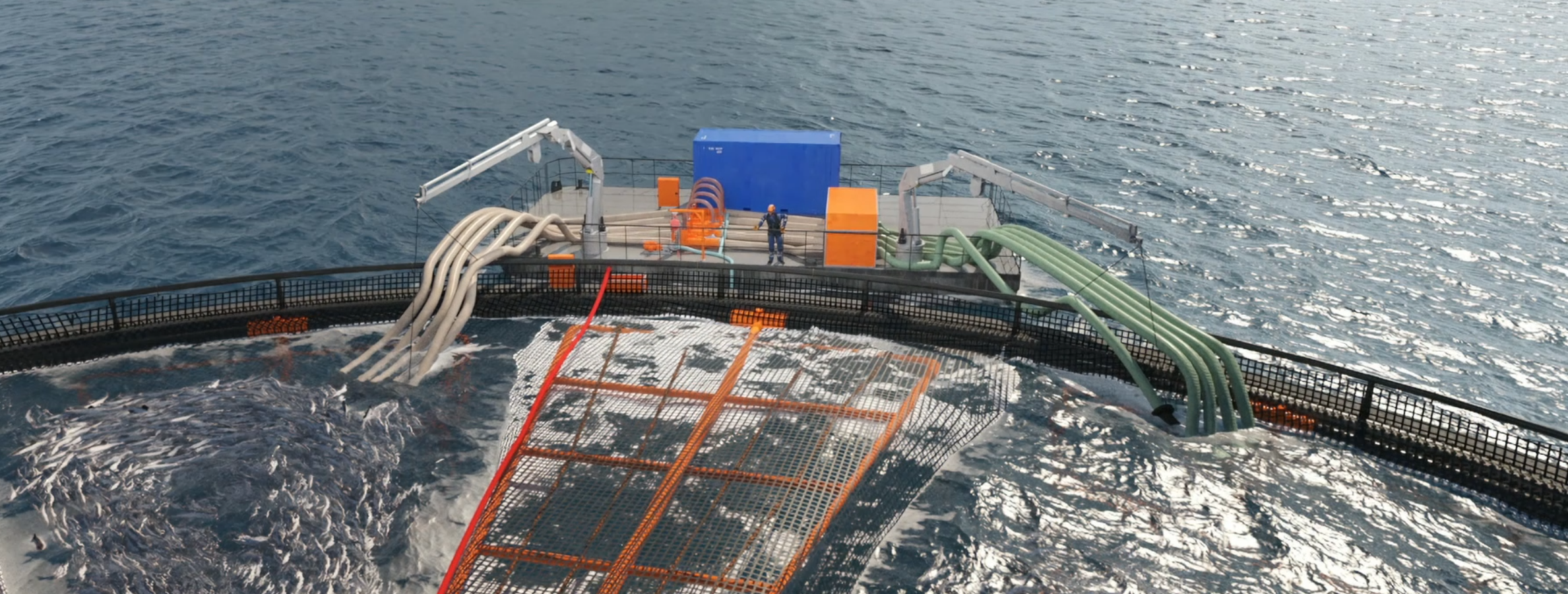
Three systems, one channel
The parts can be used on their own, but they are designed to work together.
01
Sector control
The pen is divided into sectors and the fish are moved gently between them. It replaces today's practice of starving the fish to get them where you want them.
02
Ejector transport
Live fish are lifted and moved by water flow alone. No impeller, no pinch points, no moving parts in contact with the fish.
03
PCLD delousing
Predictive Channel-Based Laser Delousing. Channel-based laser treatment under controlled passage: the camera finds the lice, the laser treats, the fish moves on.
Injector
The injector is our existing product outside aquaculture, with applications in transport and shipping. The principle is the same as in the channel: the water flow does the work, with no mechanical parts touching what is being moved.
Get in touch for specifications, capacity and applications.
Where we stand
- A patent application has been filed, and the technology has been assessed against existing patents.
- The flow is documented through CFD simulations.
- Prototypes have been built and tested in the laboratory.
- Development continues in an ongoing project with testing under realistic conditions.
Want to know whether this fits your site?
We are happy to answer questions about capacity, adaptation and what is possible today.